
In this guide, we will understand what LoRa and LoRaWAN are and how they compare to each other.
- Both are crucial for enabling efficient, low-power, wide-area network solutions for various IoT applications.
- LoRa is the underlying radio technology that enables long-range communication
- LoRaWAN is the protocol that manages how devices using LoRa communicate over a network.
How LoRa and LoRaWAN related?
LoRa and LoRaWAN are closely related. They are often confused by new users.
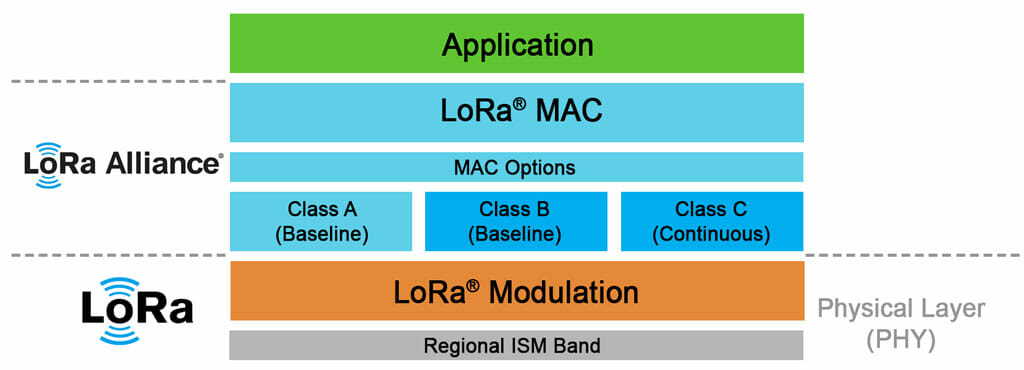
- LoRa is at Physical layer. This is just about radio: How to encode / decode radio to digital bits.
- LoRaWAN uses LoRa below and is at Data Link/ MAC layer. In this layer, LoRaWAN has addresses.
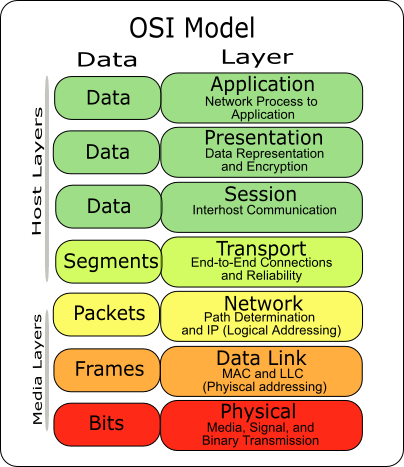
This is the standard OSI Model for networking. Yes, we do not have 5 other layers in LoRa / LoRaWAN.
- LoRa is at Physical layer for radio signal.
- LoRaWAN is at Data Link layer. That is why we have addressing in LoRaWAN.
LoRa vs. LoRaWAN?
The below table compares the differences between LoRa and LoRaWAN.
- LoRa – The long range radio
- LoRa is the radio for long-range and low-power wireless communication.
- The radio employs a spread spectrum modulation technique derived from chirp spread spectrum (CSS) technology.
- Point-to-point communication
The traffic is between LoRa nodes. You have to define the communication topology on your own.
- For small-scale or DIY projects
- No compability.
LoRa devices usually do not work together due to custom defined protocols.
- No built-in feature.
You need to code it your own.
- LoRaWAN – The protocol on top of LoRa
- LoRaWAN is a communication protocol built on top of LoRa radio.
- The protocol defines the network architecture, communication protocols, and system components for the operation of the networks.
- Star communication.
The traffic is between LoRaWAN nodes to LoRaWAN gateways and to LoRaWAN server.
- For small-scale to large scale commercial projects
- Great compatibility.
LoRaWAN gateways, nodes and servers from any vendors can work together.
- Built-in security, uplink/downlink packet format, Adaptive data rate, confirmed packets…
LoRaWAN for long-range projects
We would prefer LoRaWAN in most cases
- Mass-scale: If you want to deploy a lot of gateways and nodes, go for LoRaWAN.
- Standard: If you want your gateways / nodes / servers to be compatible with other vendors, go for LoRaWAN.
- Feature: If you want built-in security and features, go for LoRaWAN.


Will RAK7289v2 gateway work with Dragino LHT65N?
Yes, sure.
RAK7289v2 gateway is a LoRaWAN gateway.
Dragino LHT65N is a LoRaWAN node.
They work with each other as they use the same standard LoRaWAN.
And they work with our Easy LoRaWAN Cloud too.
https://iotthinks.com/easylorawan-cloud/